People with anxiety and low self-esteem are susceptible to getting caught in an endless loop of negative thinking. It is important to take stock of your thoughts because the cycle they spur can end up becoming a self-fulfilling prophecy.
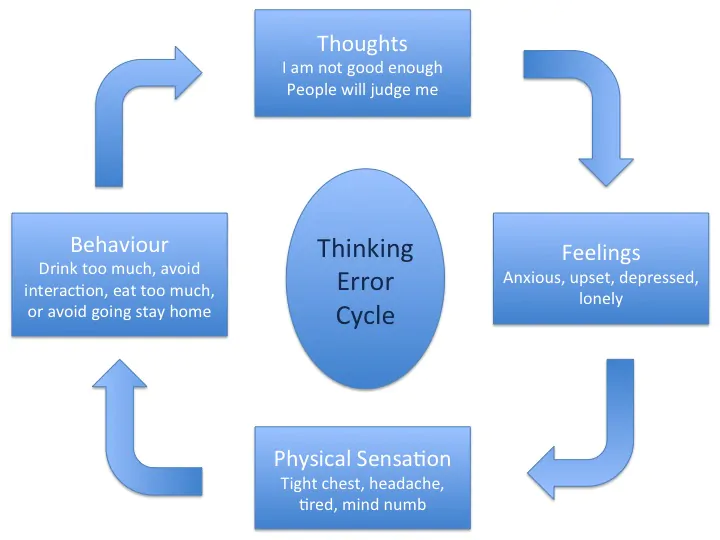
For example, a person who thinks that people don’t like him or she might start to have physical symptoms such as sweating at the very idea of being immersed in a social situation. As a result, the individual avoids parties and other gatherings, which makes him or her feel left out and eventually causes more negative thoughts such as “something must be wrong with me.” The cycle then continues, leaving the person feeling depressed or anxious. If the initial thought is dealt with appropriately, the entire cycle of negativity that follows it can be avoided.
The diagram below shows how the thinking error cycle could get triggered after someone is invited to a party, when the day of the party arrives:
Examples Of Thinking Errors and How CBT Can Help
Cognitive behavioural therapy can help you recognise when you are thinking distorted thoughts. It teaches you how to question these thoughts so they are not allowed to trigger a cycle of negativity, and it helps you replace those thoughts with more balanced ways of thinking.
These thinking errors can be strong habits that you engage in subconsciously, and a cognitive behavioural therapist can help you address specific issues and give you the tools needed to change your thoughts for the better.
Here are some examples of common thinking errors and how CBT questioning can help counteract them:
“All or Nothing” Thinking
You are constantly thinking of things in extreme terms, such as “always” and “never”. If you do something in a way that is less than perfect, you automatically conclude that you are a failure.
Examples
If you get 85 per cent correct on a test, you think you are a complete failure because you missed 15 per cent.
If you don’t look like a model, you decide you are really ugly.
You’re passed up for a promotion at work, so you think that means the company is planning to make you redundant.
Solutions
Try to find the “in between”. Remind yourself that there is usually a broad spectrum of outcomes between absolute perfection and complete disaster. Very few situations are truly all-or-nothing.
If you are thinking of something in terms of “never” or “always”, can you think of an exception? If so, that means it’s not truly “never” or “always.”
Ask yourself:
Is it really that bad or am I being extreme?
What other ways are there of looking at this situation?
Mental Filter
This occurs when you focus on the negative aspects of a situation and disregard the positives. You might be presented with a number of facts supporting a positive outcome, but you dwell only on the negative parts, even if there aren’t very many, and inflate their importance.
Example
Your presentation was well received by your superiors at work, but you noticed a typo in one of the slides. Instead of enjoying the compliments your boss gave you, you’re only thinking about the typo and expecting to get terminated soon for paying poor attention to detail.
Solutions
Focus on the concrete facts. In the example above, your boss said you did a great job. That’s a concrete fact. Don’t waste time thinking about the unknowns; the possibility of you getting sacked is an unknown.
Try to rewrite the problem or situation as though you were telling it to a sensitive child. Only include the positive parts of the story. Then read it when you’re feeling overly anxious.
Candylicious at The Dubai Mall is one of the largest sweet shops in the world. This is where you’ll find the biggest piles of chocolates, sweets, and lollipops in multiple colours, sizes and shapes. Every corner of this expertly-arranged shop is filled with more mouthwatering sweets than you could ever imagine. Come and feel mesmerised by the lollipop tree dangling with your favourites and the Candylicious Airplane taking off above your heads. This hip and fashion-forward candy store spans a whopping area of nearly 1,000sqm, so it’s safe to say you’ll find just about anything you crave here. There’s also an extensive range of sweet and chocolate brands from around the world. For the die-hard fans, there are even novelty branded gifts including T-shirts, mugs and soft toys. The sweet superstore is located directly opposite Dubai Aquarium & Underwater Zoo , so why not grab some popcorn while you spot some sharks?
What is a mood disorder? A mood disorder is a mental health problem that primarily affects a person’s emotional state. It is a disorder in which a person experiences long periods of extreme happiness, extreme sadness, or both. It is normal for someone’s mood to change, depending on the situation. However, to be diagnosed with a mood disorder, symptoms must be present for several weeks or longer. Mood disorders can cause changes in your behavior and can affect your ability to deal with routine activities, such as work or school. Two of the most common mood disorders are depression and bipolar disorder. This article will review these disorders and some of their many subtypes. Depression (major or clinical depression). Depression is a common mental disorder. Grief or sadness is a typical response to a traumatic life event or crisis, such as the death of a spouse or family member, loss of a job, or a major illness. However, when the depression continues to be present even...
In addition to treating patients, Trimble researches vaccines to treat human papillomavirus (HPV). The virus is the most common sexually transmitted infection, with more than 6 million Americans infected each year. You’ve probably seen television ads for the HPV vaccine. If you have kids, your pediatrician has probably recommended the vaccine to guard against some cancers that are linked to HPV. It can sound pretty scary: a common infection that causes cancer. So should women worry about HPV? According to Trimble, the answer is no. Women Don’t Need to Feel Ashamed About HPV “Anyone who’s ever had sex may have been exposed to HPV,” says Trimble, adding that she wishes she knew how to get rid of the unnecessary stigma associated with the disease. “Raising awareness can give you choices, and knowing you have choices is empowering.” Certain Types of HPV Are Linked with Cervical Disease While more than 100 types of HPV exist, only about a dozen of them are associate...


Comments
Post a Comment